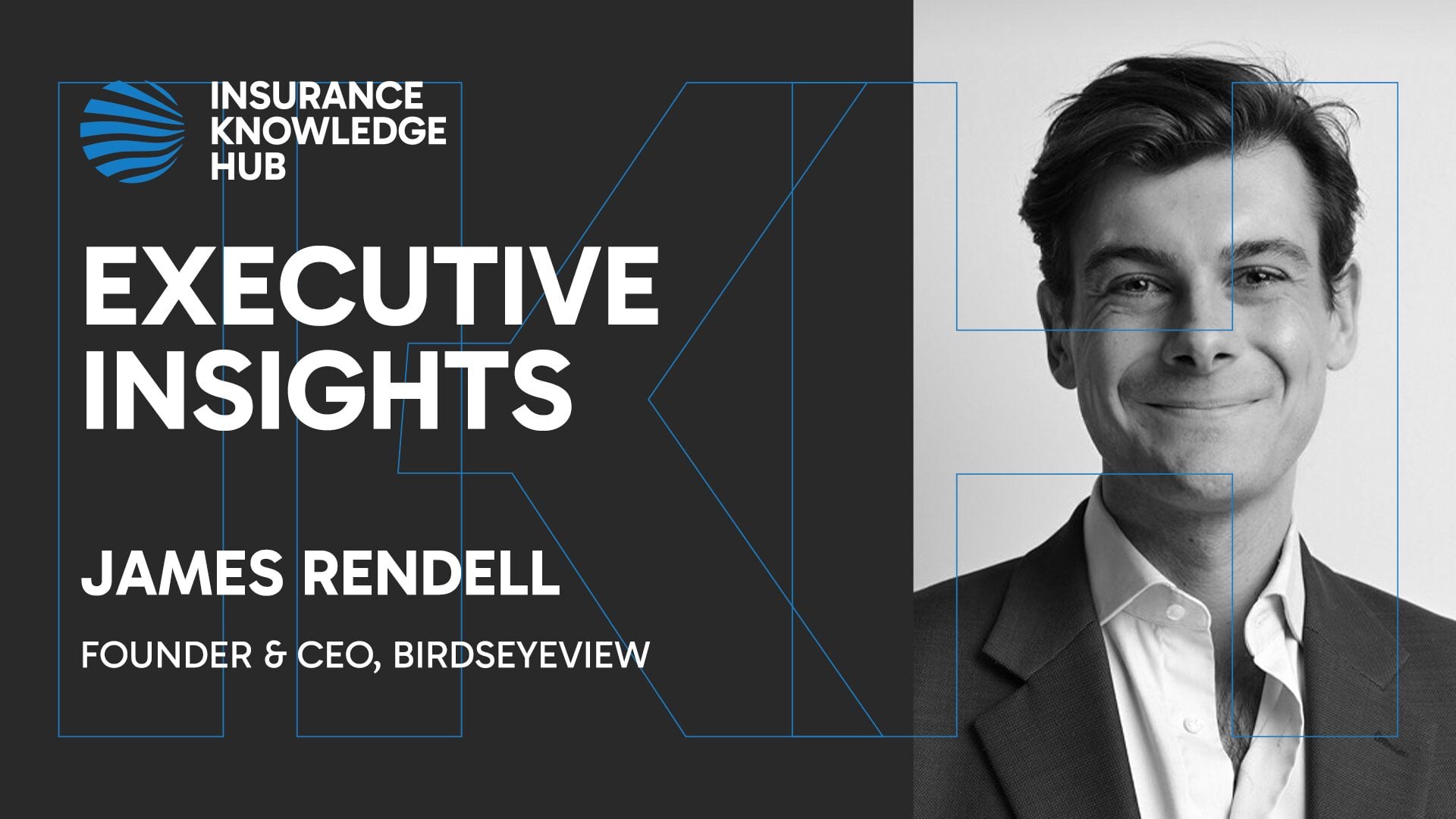
Executive Insights: James Rendell, CEO of BirdsEyeView on the launch of its enhanced ‘Catastrophic Exposure and Risk Analytics’ platform.
In this Executive Insights article, James, Founder and CEO of BirdsEyeView, discusses the launch of its enhanced ‘Catastrophic Exposure and Risk Analytics’ platform, CERA® and how it enables (re)insurers to strengthen resilience against more frequent and severe natural catastrophes.
BirdsEyeView recently secured a seven‑figure investment to accelerate international expansion and further develop your machine learning‑driven wildfire models. How does this capital enable you to balance growth in new markets with continued investment in scientific innovation?
The investment allows us to accelerate a strategy we were already pursuing, to build the best-in-class global hazard models, while expanding their availability to insurers globally.It means we can scale our commercial presence in key markets such as Lloyd’s of London, US, and Australia, while continuing to invest in the scientific team developing our machine learning hazard models. Ultimately, our growth is driven by the strength of the science behind the platform.
You recently launched your upgraded CERA® platform, which brings multi-peril hazard modelling and exposure management directly to the underwriter’s desktop. How does this shift in accessibility influence underwriting behaviours and portfolio decisions compared with traditional NatCat workflows?
Our CERA® platform addresses a long-standing challenge for underwriters: quickly understanding both the catastrophe risk of a new submission and its impact on the existing portfolio. That analysis needs to happen instantly, at their desk, and with confidence in the modelling. Traditionally this has relied on third-party catastrophe models, which can take days to return results and are not always designed for real-time underwriting decisions. By bringing multi-peril hazard modelling and exposure management directly to the underwriter’s desktop, CERA® turns catastrophe analytics from a periodic specialist exercise into a real-time decision tool, enabling faster, more informed underwriting and more proactive portfolio management.
With wildfire risk evolving rapidly due to climate change, what role do advanced AI and real‑time data play in shaping insurers modelling approach, including in the US and Australia where BirdsEyeView is now live?
With wildfire risk evolving rapidly due to climate change, insurers need modelling approaches that can adapt to changing environmental conditions. Advanced AI and real-time data are increasingly central to this shift. At BirdsEyeView, our wildfire models are built using millions of machine learning-trained data points, including meteorological conditions, vegetation and fuel characteristics, land use, and demographic factors. The models are trained on over twenty years of historical wildfire observations derived from satellite data. Through this process, the machine learning system learns the complex combination of conditions that lead to wildfire ignition and spread, allowing it to identify the environmental ‘recipe’ most likely to produce wildfire events.
Using this learned relationship between hazard drivers and historical fire activity, the model generates forward-looking wildfire risk estimates, including monthly probabilities of wildfire occurrence and annual metrics such as burn rates and return periods for full seasonal analysis.
As natural catastrophes become more frequent and severe, what broader shifts do you believe the (re)insurance industry must embrace, beyond technology, to build resilience, and how is BirdsEyeView advocating for, or enabling, those changes?
The frequency and severity of natural catastrophes are increasing, which makes accurate and accessible risk assessment more important than ever for the insurance and reinsurance industry. Beyond technology, the industry needs to embrace a more proactive and data-driven approach to understanding catastrophe exposure across portfolios. This means equipping underwriters and risk managers with tools that allow them to assess risk quickly, consistently and with greater transparency.
You’ve highlighted expansion of your team of PhD‑level scientists and climate specialists as a key use of new funding. How does building deep in‑house scientific expertise differentiate your product roadmap, and what emerging risk areas are you prioritising next?
A key differentiator for BirdsEyeView is that our catastrophe models are developed by an in-house scientific team combining meteorological expertise, natural catastrophe specialists, and machine learning researchers. This multidisciplinary approach allows us to continuously refine our models and respond quickly to emerging risk trends.
Our current focus is on improving the modelling of secondary perils, which are becoming an increasingly significant driver of insured losses but are often less well modelled. This includes wildfire, severe convective storm, and hail, where machine learning and high-resolution environmental data can provide meaningful improvements in risk assessment.
Alongside these developments, we continue to build robust models for primary perils, including tropical cyclone and earthquake. Together, this allows us to provide insurers with a more comprehensive view of catastrophe risk across both major events and the growing impact of secondary hazards.
About BirdsEyeView
BirdsEyeView (BEV) is a European Space Agency-backed Insurtech providing global multi-peril Natural Catastrophe Modelling and Exposure Management software for (re)insurers, MGAs, and brokers.
BEV’s CERA® platform delivers more accurate, real-time risk assessment at an underwriter’s desktop by combining high-resolution satellite data with advanced AI analytics to enhance pricing accuracy.
CERA®’s portfolio exposure management functionality enables carriers to monitor aggregations live and leverage real-time global hazard monitoring to support forecasted loss reporting.
BEV is trusted by more than 20 leading insurers, brokers, and MGAs worldwide, including Allianz, Liberty Specialty Markets, AXA XL, HDI, and Aon, amongst others.
For more information, visit www.birdseyeview.ai