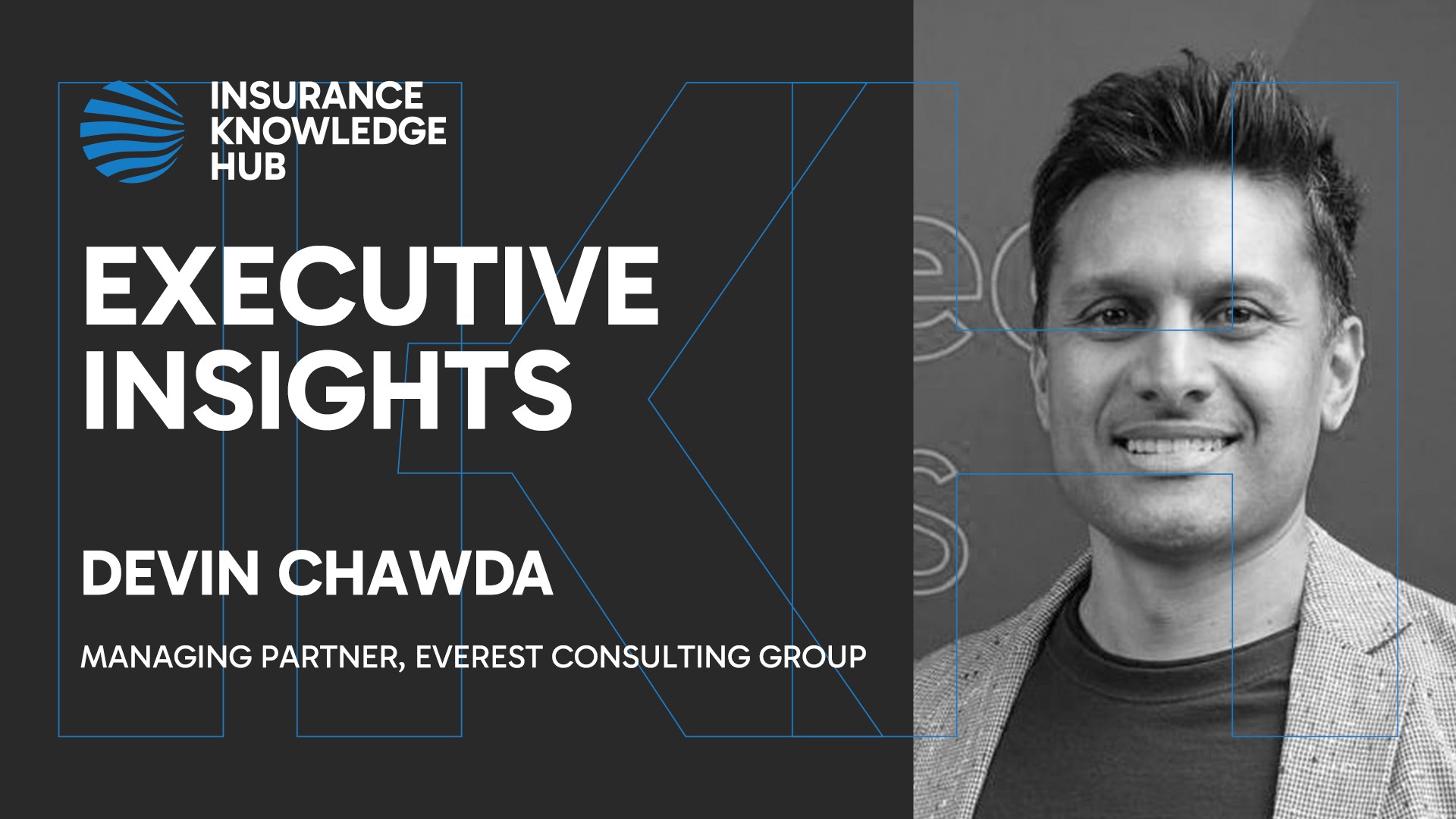

Executive Insights: Devin Chawda, Managing Partner, Everest Consulting Group
In this exclusive article, we speak with Devin Chawda, an accomplished business leader and entrepreneur with over 20 years of experience building pioneering technology ventures in the Insurtech, IoT, and Telecom sectors. He is the founder of Y-cam, a groundbreaking IoT security company he scaled to over 200,000 global customers before its successful acquisition by a global PLC in 2019. Most recently, Devin co-founded and served as CEO of the award-winning insurtech MGA, ARMD. Driven by a passion for solving market problems through innovative technology, he brings a battle-hardened operator’s perspective to every venture he leads. Devin has recently founded Everest Consulting Group, so we sat with him to discuss his new venture.
1.Looking back at the five-year journey of ARMD, what do you think the company achieved, and why do you think things did not ultimately work out?
ARMD was born out of a genuine mission to protect the backbone of the economy – tradespeople. We didn’t just create an app; we built the first real bridge between IoT hardware and insurance technology for this demographic. We took a concept from a blank sheet of paper to an MGA valued at over £5m, secured a 5 year capacity deal with an A-rated insurer, and built a network of more than 100 broker partners. Being selected for Lloyd’s Lab Cohort 9 was a major validation that the industry believed in the “prevent and protect” model we were pioneering.
In the end though, we were hot by a perfect storm. Our technology was award‑winning, our brand had strong visibility (even appearing on BBC One), and the mission resonated – but we hadn’t fully cracked the unit economics of product‑market fit. We were moving toward a bundling model with other providers, and I believe that was the right direction, but in a capital‑intensive sector like Insurtech, you need a long runway to pivot effectively.
On a personal level, I was fighting a war on two fronts. Navigating a high-stakes scaleup while my 20-year marriage was breaking down meant that, eventually, the “oxygen” ran out. I’m glad we managed to find a way to keep our hardware customers online to minimise disruption, but I am also very aware that we didn’t reach the summit our investors and team deserved. That stays with me, but it’s also the reason I am so focused on execution and fundamentals today.
2. What were the biggest lessons you personally took from building and then closing ARMD, and how have those lessons shaped your thinking as a founder today?
The biggest lesson was understanding the “Passion Gap.” I cared deeply about solving a real problem for tradespeople, but I wasn’t a tradesman myself. I realised that while I loved the mission, my true obsession has always been the intersection of business and technology. Helping others grow is what I’m truly passionate about.
I also learned that market “love” – awards, press, pitch-panel wins – is great to build awareness, but it can be a dangerous distraction if it doesn’t translate into fundamentals: revenue, renewals and loss ratios. We should have doubled down on the unglamourous but essential work of refining our product and market approach sooner.
Closing ARMD became my “Kailash moment” – a period of intense, often painful reflection. I realised that a founder is the business’s most valuable asset. If you’re not “ECG” ready – full of Energy, Clarity, and a plan for Growth – the business won’t be either. Today, I don’t chase vanity metrics, instead building for sustainability, unit economics, and execution. ARMD was the advanced degree I needed to become a better partner for other founders.
3. The insurtech sector has seen both rapid growth and a number of high-profile challenges in recent years – what does ARMD’s experience say about the realities of building a startup in that space?
It’s a cliché because it’s true: meaningful change in insurance is incredibly hard! There’s a constant tension between exploring the new and continuing to make money the way things have always been done. Innovation fatigue is real, especially after so many promising ventures have struggled.
ARMD’s journey highlighted the “Capacity Gap.” In Insurtech, no matter how strong your technology is, you are ultimately dependent on carrier appetite, regulatory complexity, and the realities of the MGA model. The “valley of death” between Seed and Series A is wider here than almost any other vertical because of the capital and compliance requirements.
It also reflects the shift from “Growth at all costs” to “Efficiency at all costs.” ARMD was built during a growth era. Today’s founders need to be leaner, more modular, and able to “plug and play” their technology rather than trying to boil the entire insurance ocean. If you can’t demonstrate real commercial traction early, you’ll spend your time chasing momentum instead of building it.
4. You’ve now launched Everest Consulting Group – what problem are you aiming to solve with this new venture, and how is it different from what you were trying to do before?
With ARMD, I was building a product for one very specific niche. With Everest Consulting Group (ECG), I’m building the partner of choice for ambitious founders across industries.
The data shows most SMEs and scale‑ups either fail or hit a plateau. They have the ambition, the ideas, and often the early traction – but they often lack the real‑world operational firepower to reach the next peak. They don’t need a big consultancy that spends days in workshops and leaves them with a slide deck. They need people who have lived the chaos, raised the capital, built the teams, and navigated the hard times. That’s the gap ECG fills. We’re about execution over theory.
Our core product is the ECG Review – a high‑impact, fixed‑price diagnostic that gets under the hood of a business in a single day’s work. We look at the vital signs: commercial model, operations, technology, people, and growth levers. The output isn’t just a report; it’s an actionable set of priorities that founders can execute immediately. From there, we “plug in” as hands‑on partners – whether that’s AI transformation, fundraising or M&A strategy. I’m no longer climbing one mountain; I’m helping others climb theirs, with a select team of operators who’ve actually been there and done it. ECG is the company I wish I’d had beside me during the ARMD journey.
5. For founders and investors watching, what advice would you give about navigating setbacks or business failure and turning that experience into something constructive?
To Founders: Don’t hide from the failure — own it. The industry respects a founder who has been in the ring, even if the outcome wasn’t what they hoped for, far more than someone who has never taken a swing. I’ve been fortunate to have experienced both a “successful” and “unsuccessful” exit, and the truth is: the learning comes from the latter. Use the setback to gain a summit view of your skills. What did you do well? Where did you struggle? What energised you? What drained you? Then pivot your identity toward your expertise, not your last company name. And above all, trust the process. Resilience is built in the valley, not at the peak.
To Investors: Look for the second‑climb founders. The ones who have navigated a liquidation, a pivot, or a near‑miss are often far more capable than first‑timers. They know where the crevasses are. They understand oxygen management — financially, emotionally, and operationally. They’ve learned the discipline that only comes from being tested. And this is also where Everest Consulting Group is a powerful partner. I’ve lived both sides — founder and operator, success and failure — I can support investors with due diligence, portfolio diagnostics, and stepping in as an interim operator when a company needs stabilising or accelerating. Sometimes the difference between a write‑off and a turnaround is simply having someone who has been through the fire before.
Failure isn’t a full stop. Failure can also be viewed simply as change. A detour on a map that often leads to something unexpected. My own journey – from Mount Kailash to Mount Everest – taught me that sometimes you have to descend before you can climb the bigger peak. And often, that second climb is where the real value is created.
About Everest Consulting Group