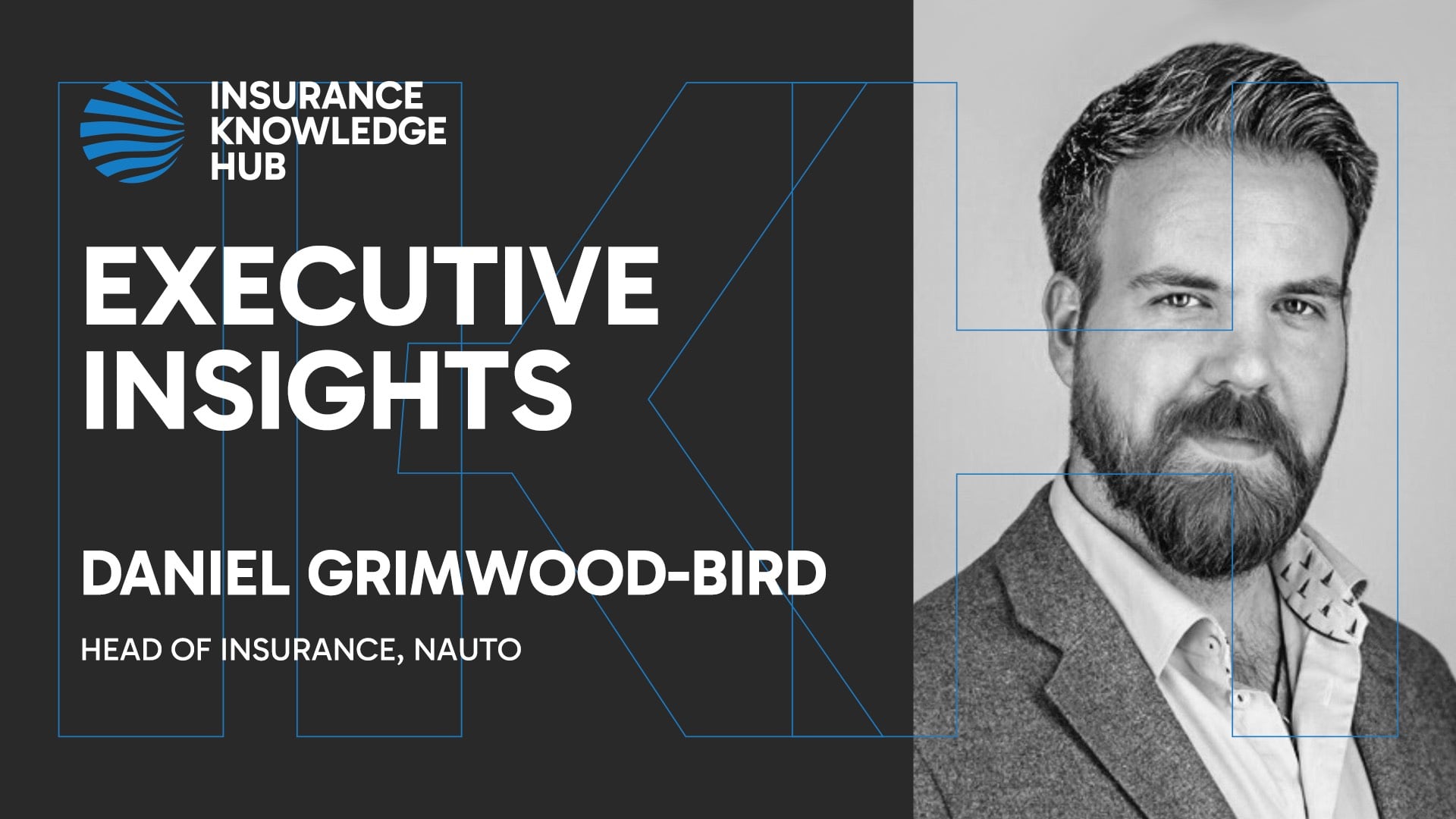

Executive Insights: Daniel Grimwood-Bird, Head of Insurance, Nauto
In this edition of our Executive Insights series, we speak with Daniel Grimwood-Bird, a senior insurance and insurtech leader with more than two decades of experience spanning underwriting, risk intelligence, and technology-led loss prevention. As Head of Insurance at Nauto, he is focused on helping insurers move upstream from loss financing to loss prevention through predictive, in-vehicle AI. Daniel hosts the Humanizing Insurance podcast and is a regular speaker at global industry events.
You’ve recently stepped into a new role at Nauto. What perspectives or priorities are you bringing with you, and how do you see this next chapter shaping your thinking on the future of insurance?
The first thing I need to mention is the quality of what the team at Nauto has already built. There’s a tendency in our industry to talk about the future in quite abstract terms, but here you can see, very clearly, what happens when those ideas are actually put into practice at scale. I’ve been in insurance for 20 years and, across all lines, there’s been a growing realisation about how significant this moment is for insurance when you look at it through the lens of what technology is now enabling.
One of the things Stefan Heck, my CEO, says that has really stayed with me is that AI will have a bigger impact on road safety than the introduction of seatbelts. It’s a bold statement, but when you unpack it, it starts to feel less like hyperbole and more like a reflection of what becomes possible when you move from passive protection to active intervention. Seatbelts were designed to protect you in the event of an accident. What we’re now seeing is the ability to reduce the likelihood of that accident happening in the first place.
For me, that fundamentally shifts how you think about insurance. It moves the industry from being something that responds brilliantly when things go wrong, to something that has a far more active role in ensuring they don’t go wrong at all. This next chapter is less about changing what insurance is at its core, and more about expanding what it can be, particularly when you bring real-time insight and intervention into the equation.
You created the Humanising Insurance podcast to spotlight people and stories across the industry. What motivated you to start it, and what impact do you hope the conversations have on listeners?
The podcast really came from a growing sense that the way insurance is talked about externally doesn’t reflect the reality of the people within it. Insurance absolutely deserves scrutiny. It operates at moments of vulnerability, it deals with life-changing events, and it does get things wrong. That isn’t the issue. What struck me over time was how easily the people behind those decisions get lost in the narrative.
An entire profession can end up being reduced to a single, fairly negative archetype, which doesn’t align with what I’ve experienced over the last twenty years. I’ve seen the flaws in the industry, but I’ve also seen the effort, the care, and the genuine sense of responsibility people bring to their roles, particularly when they’re dealing with complex or sensitive situations. That gap between perception and reality was really the catalyst. If the industry is going to be judged, it should at least be understood, and the only meaningful way to do that is to introduce the people behind it.
There was also a more personal frustration driving it. We often say that insurance is a people industry, but much of the conversation today is dominated by technology, platforms, and innovation. At the same time, with more remote and distributed ways of working, those informal moments where you learn from others, where you hear the stories and pick up the nuance, are becoming less common, particularly for people earlier in their careers.
Humanising Insurance was my way of recreating some of that. To capture the thinking, the journeys, and the lived experiences of people across the industry in a way that others can access, wherever they are. In many ways, it’s a love letter to the industry, but one that doesn’t ignore its flaws, it makes sure we don’t lose sight of the people behind it.
There’s a growing view that insurers should move beyond simply pricing risk and paying claims to actively preventing losses. What does that shift look like in practice, and how far along is the industry in making it a reality?
Insurance has always played a role in prevention, even if we don’t always describe it that way. If you look at commercial property, for example, the widespread adoption of sprinklers, fire doors, and smoke detection systems has been driven in no small part by insurers recognising that preventing a loss is far more effective than simply paying for one after the fact.
What’s changing now is not the principle, but the scope and the immediacy of that prevention. We’re starting to see similar approaches extend into other lines, whether that’s water pressure sensors in home insurance helping to prevent escape of water claims, or technologies that give a much more continuous view of risk as it develops. The more interesting frontier is where prevention intersects with human behaviour. Road safety is a good example of this, because a significant proportion of losses ultimately come down to decisions made in the moment, whether that’s distraction, fatigue, or simply poor judgement.
The question is whether technology can meaningfully influence those behaviours in real time. For a long time, the answer was probably no, at least not in a consistent or scalable way. What we’re now seeing is that it can, and that opens up a very different conversation about what prevention actually looks like in practice.
AI is often framed around efficiency and cost reduction, but you’ve spoken about its potential to expand capability instead. How should insurers rethink the role of AI if they want to drive better outcomes rather than just reduce costs?
A useful way to think about AI in insurance is to imagine the ideal, even if unrealistic, scenario and then work backwards from it. If you could design the perfect risk management model, you might start by saying that every insured fleet should have an experienced risk manager sitting alongside every driver, continuously observing, coaching, and intervening where necessary to keep them safe. It’s clearly infeasible in the real world, both operationally and economically, but it’s a helpful thought exercise because it defines what “good” looks like.
What AI does is allow you to get much closer to that ideal without the constraints that would normally make it impossible. It enables continuous oversight, contextual understanding, and timely intervention that simply couldn’t be delivered at scale by people alone. Seen in that context, AI isn’t replacing the role of the risk manager, it’s extending it. It allows their expertise to be applied far more broadly and consistently than would otherwise be possible, which in turn changes the nature of the outcomes you can achieve. The insurers that benefit most will be those that think about AI in those terms, as a way of scaling capability rather than just reducing cost.
I’ve heard you describe insurance as an ‘apex industry’ with the ability to influence behaviour and improve outcomes at scale. Where do you think the industry is underutilising that influence today, and what would it take to fully realise it?
I remember reading an interview many years ago where insurance was described as an apex industry which stuck with me as it’s absolutely right. Very little happens in the modern economy without insurance sitting somewhere in the background, which gives the industry a unique ability to influence not just individual decisions, but entire ways of operating.
Historically, that influence has been exercised largely through pricing and underwriting. We signal what good looks like, we incentivise it through lower premiums, and we respond when things go wrong. That model has worked remarkably well, but it is, by its nature, somewhat removed from the moment in which risk actually materialises. What is now becoming possible is a much more immediate form of influence, where insurers can play a role not just in reflecting risk, but in actively shaping it as it happens, or even just before it happens. That is a meaningful expansion of the industry’s role.
If done well, it moves insurance beyond being purely a financial safety net and towards something that contributes more directly to better outcomes in the real world. And ultimately, that is where the industry has the opportunity to have its greatest impact, not just in how it responds to risk, but in how it helps reduce it in the first place.
About Nauto