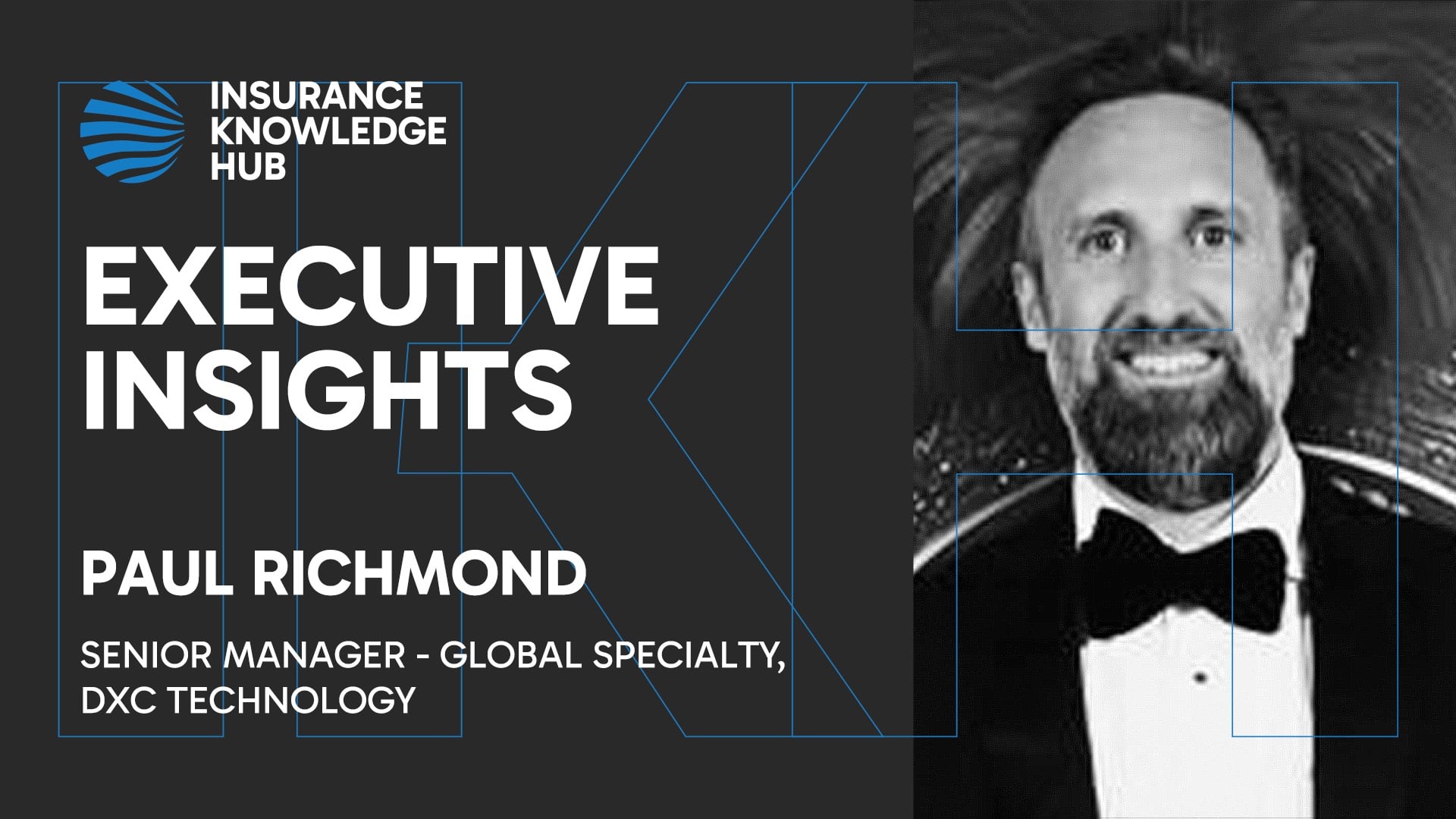

Executive Insights: Paul Richmond, Senior Manager, Global Specialty, DXC Technology
In our latest Executive Insights article, we speak with Paul Richmond, a senior leader within the insurance sector with experience across Retail and Wholesale Broking / MGAs, Innovation, and the vendor ecosystem. Having led Change, Product, Operations, and Customer Success functions and with strong connections across the market communities, Paul’s focus is anchored in driving better outcomes for colleagues and customers – through positive change and modern technology adoption – most recently joining the Global Specialty vertical at DXC. We sat down with him to discuss the challenges and opportunities shaping transformation, customer value, and technology adoption across the insurance market.
Many insurers and brokers are still investing heavily in digital transformation, but results can feel uneven. In your experience, what separates initiatives that deliver real customer and business outcomes from those that remain largely theoretical?
Focus on an actual business problem – not a technology dream!
Your staff, partners, and customers can all highlight opportunities for change that add real value to your business. I have held two roles in my career—Change Manager at Price Forbes and Product Manager at Novidea – that deeply embedded a mindset of treating change like a product. By this, I mean applying a strong product focus to initiatives: strict prioritisation, clear requirements, openness in solution options, measurable outcomes, and rapid feedback. The longer something goes unseen or untested, the more likely it is to drift away from its core objective and the easier it is for the exec to stop any investment.
There’s growing emphasis on ‘customer-centricity’ across the insurance market. How can organisations move beyond the rhetoric and actually embed data-driven decision-making that delivers measurable customer value?
Who is your customer, and what do they need from you!
I’ve spent a significant amount of time trying to formalise this question—most recently as Head of Customer Success at Novidea, and now in my new role at DXC Technology. We are drawn to the insurance market because of the many paths the value chain can take, particularly in the Specialty London Market. That chain might start with a tier-one reinsurer in Germany and extend all the way to a kidnap & ransom policyholder somewhere in Latin America – that is a lot of ‘customers’.
Vendors occupy a unique position within this ecosystem. They have access to system of record data collected over many years, as well as huge third‑party data sets. And now with the growing accessibility of large language models (LLMs), we can now process and interrogate this data in ways that were not previously possible.
The real opportunity lies in moving beyond static, user‑driven data requests into a space that delivers actionable insight. This means shifting toward predictive models that surface insights users may not even think to ask for—ultimately enabling better decision‑making, improved customer journeys, and stronger outcomes.
A lot of transformation conversations focus on improving outcomes for clients – but less attention is paid to internal change. How important is it for organisations to prioritise internal experience and operations as part of their transformation strategy?
Transformation starts at home!
With the changing landscape of AI, the past five years have seen a significant shift towards operational efficiency—and it’s a change I welcome. Delivering something innovative is no longer enough if it’s done poorly. Organisations that fail to operate efficiently eventually face negative sentiment from their customers – as it can’t stay hidden.
I strongly believe in practising what you preach. My experience shows that organisations which progress their own digital journey—by upskilling their people and embedding the right level of technical capability—have a far greater chance of delivering successful outcomes for their customers. Building a truly digital culture takes time and sustained effort. It is achieved through ongoing investment in training, clear direction aligned to business values, and continuous feedback on the changes being made, all focused on driving incremental improvement.
AI is often described as a competitive differentiator, yet many organisations are still early in their adoption. Do you see AI as something that will define market leaders – or more as a baseline capability that firms simply can’t afford to ignore?
Do more-smarter, for less…
At the recent Insurtech Insights conference, two messages came through loud and clear:
- Get your data strategy in order before embarking on an AI journey.
- AI won’t define the winners – but it will define the losers.
Across the insurance industry, there is a wide spectrum of AI adoption. Some organisations have yet to apply even a basic capability model to their business, while others are actively positioning themselves as digital partners – fast follow syndicates, headless underwriting, automated submission scoring.
From conversations with colleagues, higher rates of adoption consistently appear to be driven by stronger data health strategies. This typically means clear accountability for data accuracy, embedded quality controls, and transparency around data lineage. When these foundations are in place – and the pipeline is fed with high‑quality data—the impact and appetite to extend AI usage increases exponentially.
Ultimately, organisations that aspire to a “10x workforce,” or deliver actionable insights to users and customers, or operate on scalable AI architecture, are those best positioned for success. These firms that can apply that capability when delivering high‑quality products or services, and that’s where real competitive advantage lies.
From your experience across operations, product, and customer success, where do organisations typically struggle to bridge the gap between strategic ambition and practical execution in transformation programmes?
Cross‑functional communication and a clear operating model.
If we focus on the vendor landscape, it’s worth acknowledging upfront that selling any product or service is inherently challenging. However, a recurring issue I observe is a short‑term, quarter‑to‑quarter mindset. While a mid‑ to long‑term strategy may exist in theory, teams are often pulled off course by immediate pressures, losing sight of a shared objective.
Effective cross‑functional communication is critical in addressing this. Top‑level goals must cascade meaningfully throughout the organisation so that every individual understands their role, and how their success or failure impacts others. Transparency, coupled with a clear understanding of how one’s responsibilities fit into the broader picture, is essential.
Finally, operating models are often only formalised once a business is already in motion. While everyone may “know” what they are doing, it is worth questioning whether the work is being done in the most effective way, and whether there are alternative paths to success. This links closely to the need for clear cross‑functional objectives: understanding your position in the value chain, who consumes your output, and ensuring that every decision is ultimately made with the customer at its core.
Large insurance organisations often operate across multiple systems, geographies, and business lines. What are the biggest challenges in scaling transformation or innovation across that complexity – and how can leaders overcome them?
Protect Extend Transform.
Since joining DXC Technology, I’ve been really impressed by its customer‑led strategy of Protect, Extend, Transform. I believe this approach is highly applicable to large insurance organisations, as it firmly sits within the discipline of change management.
First and foremost, the focus should be on stabilising and safeguarding existing services and customers. This includes having a clear understanding of where both the strengths and risks lie within the business – whether that relates to succession planning, an ageing technology stack, or the pace of product innovation.
From there, organisations can identify clear opportunities to extend current products and services. This is where incremental change plays a key role: establishing strong feedback loops, monitoring value, and actively engaging the business as part of a continuous change mindset. Once this operating model is mature, transformation can be scaled with confidence, guided by internal data as well as industry benchmarking.
Beyond this, partnerships should not be overlooked. Some opportunities may come from unexpected places, and often there will be organisations that have already achieved similar outcomes or can offer valuable insight into the options available.
About DXC Technology
DXC Technology (NYSE: DXC) is a leading enterprise technology and innovation partner delivering software, services, and solutions to global enterprises, helping them harness AI to drive real business impact at a time of exponential change. Within DXC, the Insurance Software and Business Process Services (ISB) business unit delivers purpose‑built platforms, software, and services that enable brokers and insurers to modernize incrementally, protecting core operations while extending capabilities and transforming how work gets done.